


Building a Rube Goldberg machine is one of the most creative and satisfying projects you can take on. But here’s the thing, most machines fail not because of a bad design, but because of the wrong materials.
Every step in your chain reaction needs the right material to do the right job. A ball that rolls too fast, a ramp that’s too steep, or a trigger that’s too weak can stop everything cold.
In this blog, you’ll learn exactly which Rube Goldberg materials work best for motion, direction, triggering, and force control, and how to put them all together.
How to Choose the Right Materials for Each Step
Not every material works for every role. Before picking anything, ask: what does this step need to do?
Every step in a chain reaction falls into one of four jobs:
- Move: something needs to travel from one point to another
- Guide: movement needs to stay on a set path
- Trigger: one action needs to set off the next
- Stabilize: everything else needs to stay in place while it happens
Match your material to the job first. A lightweight plastic cup can’t reliably trigger a heavy domino. A slippery surface can’t guide a marble accurately.
Choosing randomly, even with great-looking setups, breaks the chain. Function always comes before availability.
If you’re figuring out how all these pieces come together, go see complete chain reaction examples you can try that show how each step connects in a real setup.
Materials that Create Reliable Motion

Movement is where every chain reaction starts. The material you choose here sets the tone for everything that follows.
Rolling Materials
Marbles, tennis balls, and toy cars are the most consistent motion starters. They have low friction and move in a predictable direction on a smooth surface.
Common failures include:
- Rough or uneven surfaces that slow or redirect the roll.
- Bumps that knock the ball off course.
- Misaligned starting positions that send it the wrong way.
Always test your rolling material on the exact surface you plan to use.
Gravity-Based Drops
Heavy objects like books, filled containers, or weights create a strong downward force. This makes them great for triggering the next step with impact.
The key factors here are height and stability. Too little height means too little force. An unstable drop path means the object lands in the wrong spot.
When Motion Becomes Unreliable
Even good materials fail under these conditions:
- Too light: can’t pass enough force to the next step
- Too fast: skips over the trigger entirely
- Uneven surface: sends motion in an unpredictable direction
If something keeps failing, check these three things before changing the material entirely.
Materials that Control Direction without Breaking Flow
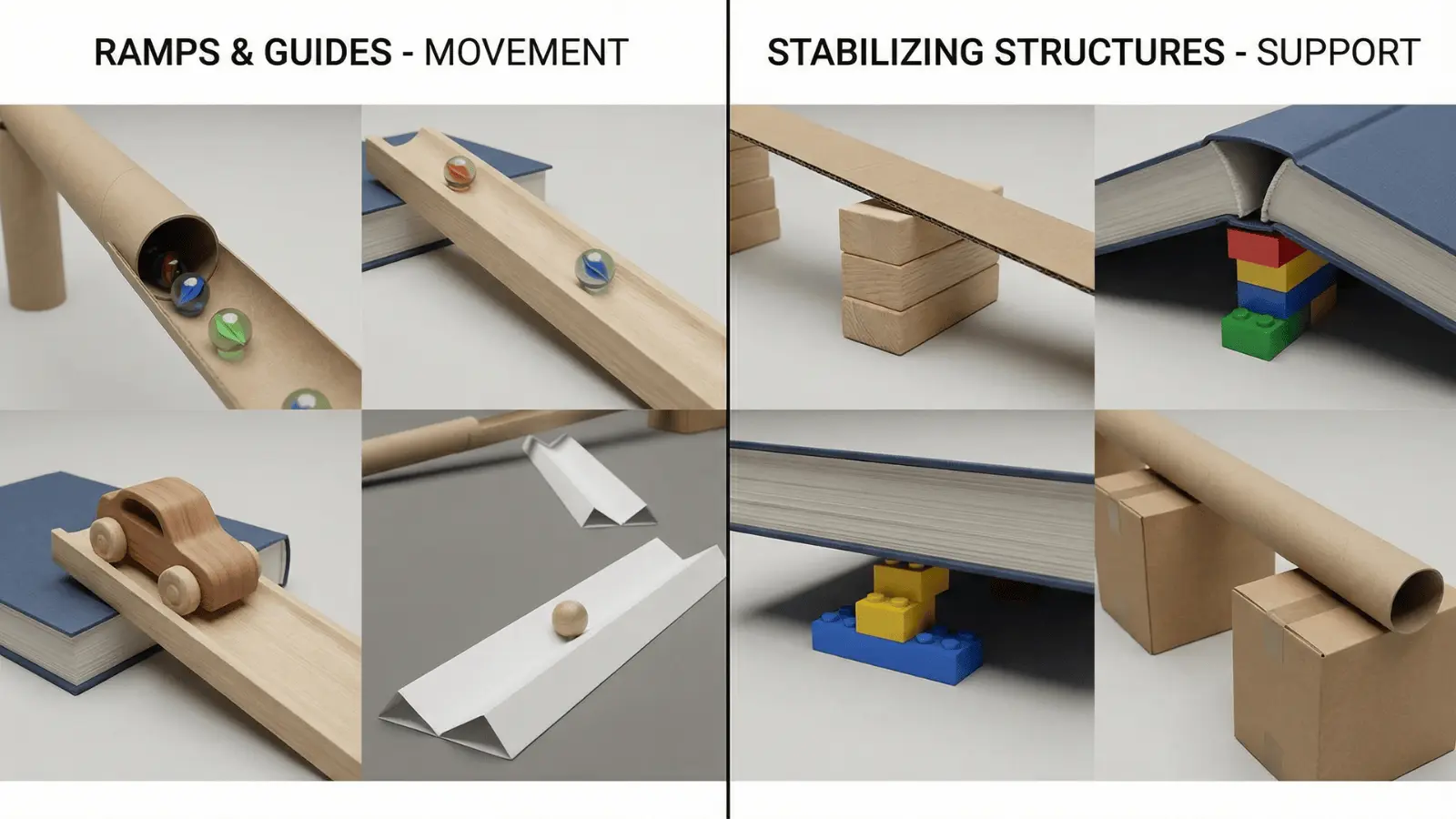
Motion alone isn’t enough. It needs to arrive at the right place at the right time.
Ramps and Guides that Actually Work
Cardboard strips, hardcover books, and paper tubes all work well as guides. They’re easy to angle and adjust.
Angle is everything here:
- Too flat → the object slows down and stops
- Too steep → it overshoots the target
Start at a medium angle and test. Adjust in small increments.
Stabilizing Structures
Blocks, boxes, and Lego pieces hold your ramps and guides at the right height and angle. Without solid support, even a perfect ramp shifts mid-run and breaks the chain.
Watch out for flexible materials like thin cardboard used as supports, they bend under weight and throw off alignment.
Materials that Trigger the Next Action Reliably
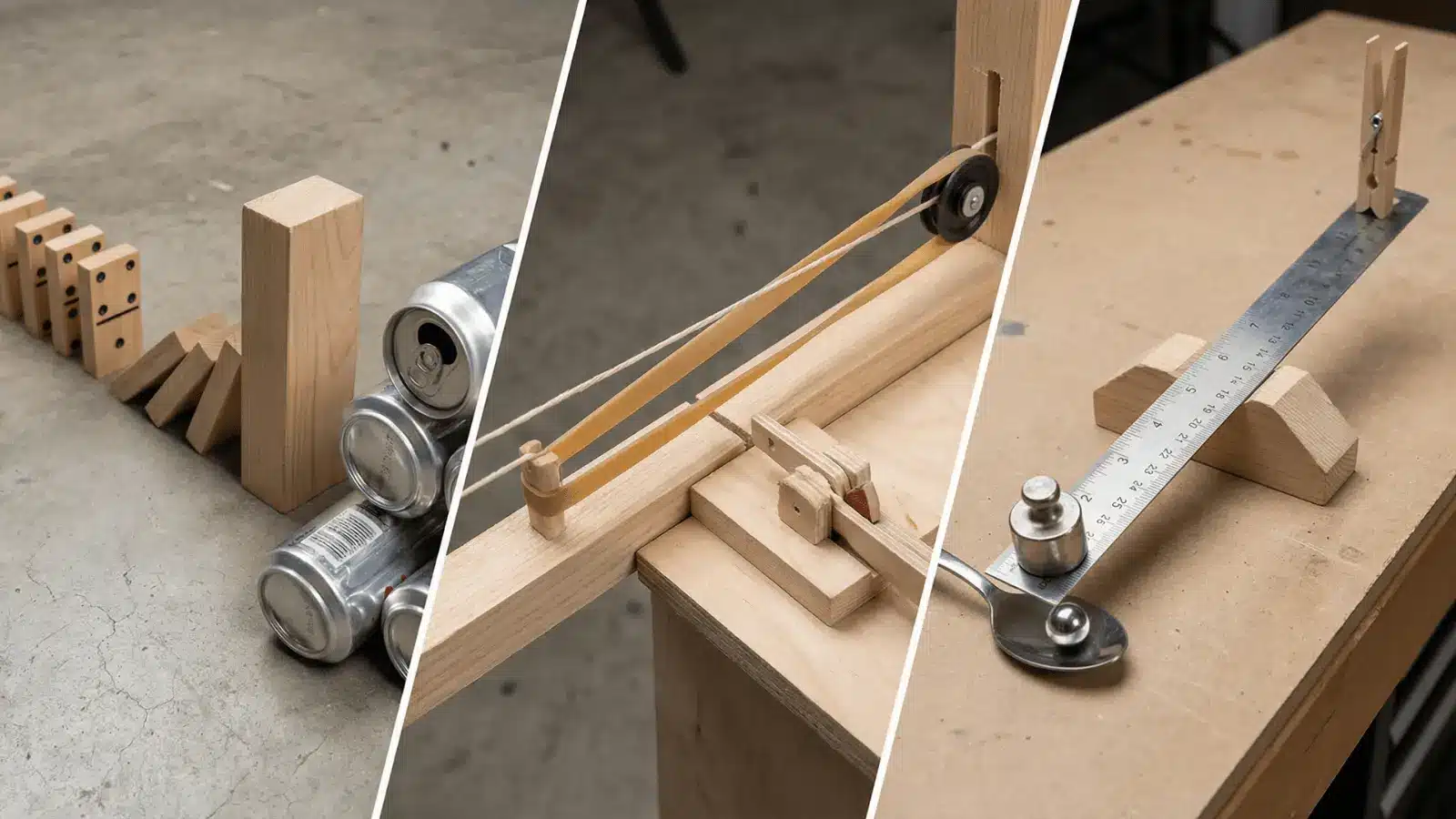
This is the most critical part. A trigger is only reliable if it transfers force consistently every single time.
Domino and Impact Triggers
Dominoes, stacked blocks, or lined-up cans pass force sequentially. Each one falls and hits the next.
Spacing is the biggest factor. Too far apart, and the force doesn’t reach. Too close and they fall together without a clean transfer.
String and Tension-Based Triggers
String and rubber bands store energy and release it on cue. They’re great for connecting steps across distance.
Two things go wrong here:
- Slack: a loose string absorbs energy instead of transferring it
- Too much tension: can pull your setup apart before the trigger fires
Keep the string taut but not strained.
Lever-Based Triggers
Rulers, spoons, and clothespins act as levers. A small input force on one end creates a larger action on the other.
The failure point is almost always the balance point or pivot. If it’s off, the lever won’t respond to the incoming force. Test the pivot location before connecting it to the chain.
Materials that Control Force and Prevent Overload

Too much force destroys alignment. Too little fails to trigger. Controlling force is what keeps your machine running smoothly.
Containers like cups, bottles, and funnels let you guide or release materials in a controlled way. Weights, coins, nuts, water-filled bottles, let you increase force gradually.
A few edge cases to watch:
- Water adds weight, but it shifts as the container moves, changing the center of gravity
- Moving containers can tip or swing in ways that send force in the wrong direction
Always secure containers and test them with weight inside before adding them to the full chain.
How to Combine Materials Into Working Mini-Steps
Individual materials only matter when they work together, especially when you understand how to structure each step for a working school project where every action must trigger the next. Think in small units, three to four elements that form one reliable mini-step.
Basic Motion → Trigger Setup
The simplest combo: a ramp feeds a ball, which hits a domino. This works because energy transfers in a straight, predictable line.
The most common failure here is misalignment. The ball exits the ramp slightly off-center and misses the domino entirely. Always check the exit angle after every test.
Delayed or Controlled Release Setups
A string tied to a weight held by a latch gives you timing control. The latch releases the string, the string pulls the weight, and the weight triggers the next step.
Friction on the latch and a weak pull are the two failure points. Make sure the release is smooth, and the pull is direct.
Multi-Material Interaction Points
When you combine ramps, levers, and weights in one section, complexity goes up, and so does failure risk. Each added element is another point where things can go wrong.
Simplify wherever possible. If a two-element setup can do what a four-element setup does, use two.
How to Test Materials Before Final Assembly
Never connect the full chain until each step works on its own.
Test each step by asking two questions:
- Does it move or trigger consistently?
- Does it work three times in a row without manual adjustment?
If the answer to either is no, fix it before moving on. Common patterns to look for:
- Works once but not again, usually an energy or alignment issue
- Requires a nudge to get started, pivot, angle, or weight needs adjustment
Fixing issues at the step level saves you from full-chain failures later.
Smart Material Substitutions Using Household Items
You don’t need a special kit. Most Rube Goldberg materials are already in your home.
Here are practical swaps based on function:
- Books instead of blocks, same height and support, heavier for stability
- Paper tubes instead of pipes guide motion just as well for lighter objects
- Coins instead of calibrated weights, easy to stack and adjust force in small increments
The rule is simple: match the function, not the material. A paper tube that guides a marble accurately does the same job as a plastic pipe.
Don’t wait for the “right” supplies. Use what works.
Final Material Check Before You Build
Before connecting everything, run through this quick check for each step:
- Does it have a clear motion source?
- Is the path guided and aligned?
- Will the trigger fire reliably?
- Can it repeat without resetting?
- Is everything secured and stable?
If every step passes, you’re ready to run the full chain. If even one step fails this check, fix it now. A single weak link will stop the entire machine.
Take your time here. This final check is what separates a machine that runs once from one that runs every time.
Conclusion
Getting your Rube Goldberg materials right is the difference between a machine that works and one that stops after two steps. Match every material to its role, test each step before linking it, and keep your setups as simple as possible.
When something fails, check motion, alignment, and force, in that order. Small fixes at the right points make the whole chain reliable.
Ready to build? Start with one mini-step, get it working perfectly, then expand from there.


