

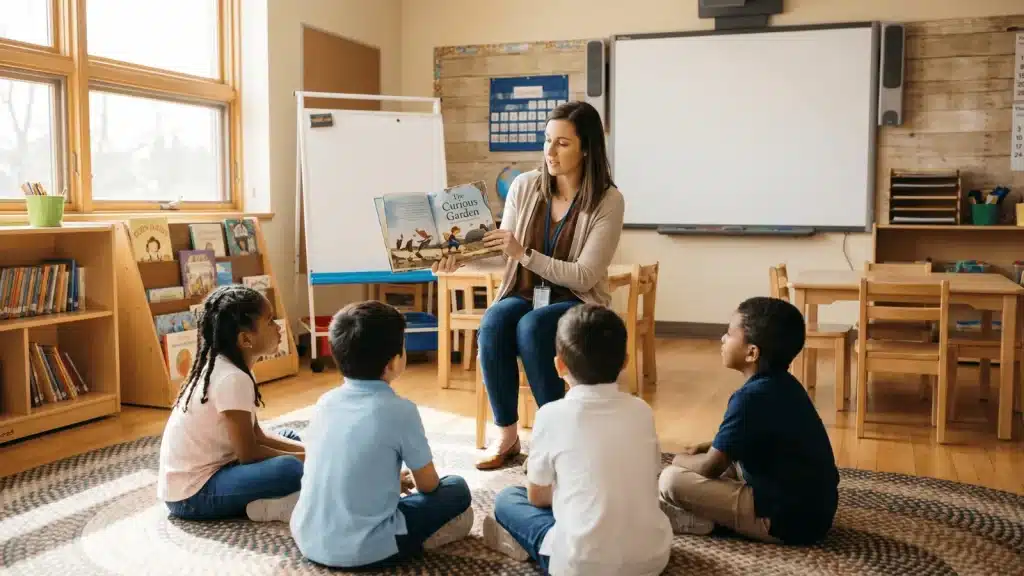
Teaching The Giving Tree is more than just reading a book aloud. It’s about helping students feel the story, think about it, and connect it to their own lives.
But here’s the thing: most lessons miss the mark because of poor timing, too many activities, or a disconnect from the story’s message. This blog walks you through how to plan, sequence, and run activities that actually deepen understanding.
If you’re teaching young children or older students, you’ll find a clear, practical approach that keeps the story’s meaning at the center.
Before planning activities, make sure you’re clear on the story and what it’s really saying in this full breakdown of The Giving Tree.
When to Use Activities While Teaching The Giving Tree
Timing your activities well makes a huge difference in how much students take away from the lesson.
Before reading, keep things light. Ask simple questions like “Have you ever given something to someone you care about?” This activates thinking without spoiling the story’s themes.
During reading, pause only at key turning points, the moments where the tree gives something significant. Too many interruptions break the story’s emotional flow.
After reading is where most activities belong. This is when students have the full picture and can reflect meaningfully.
Getting the timing wrong leads to shallow engagement.
For example, doing all activities after reading, without any guided buildup, often means students are just going through the motions. They complete tasks but don’t really process what happened.
Step-By-Step Core Lesson Flow: From Reading to Activity

A structured flow keeps the lesson focused and prevents cognitive overload.
Here’s a sequence that works:
- Step 1: Read aloud without stopping. Let the story breathe. Students need to experience the full narrative before analyzing it.
- Step 2: Revisit key moments with targeted questions. Go back to specific scenes. Ask what the tree felt, what the boy wanted, and how things changed over time.
- Step 3: Identify giving vs. taking patterns. Help students notice the repeated cycle. This builds a framework for deeper thinking.
- Step 4: Transition into one focused activity. Just one. Not two, not three. One well-chosen activity does more than a handful of loosely connected ones.
Sequencing prevents cognitive overload and improves retention. When students jump straight into crafts without processing the story first, the activity loses its purpose.
It becomes just a task, not a learning experience.
How to Choose the Right Activity Based on Learning Goal
Not all activities serve the same purpose. Picking the right one depends on what you want students to walk away with.
To guide students better, it also helps to understand the deeper message of the story, which is explained clearly in this breakdown of the real lesson.
If the Goal is Story Understanding
Use sequencing or retelling activities. Ask students to arrange story events in order or retell the story in their own words.
This reinforces structure and recall, two things students need before they can think critically about any text.
If the Goal is Theme Interpretation
Use discussion or writing prompts. Ask questions like “What do you think the tree represents?” or “Was the relationship between the boy and the tree fair?”
This pushes students past surface-level events and into the meaning behind them.
If the Goal is Personal Connection
Use “giving tree” or gratitude-based activities. Have students draw or write about someone who gives a lot in their life, or reflect on a time they gave something without expecting anything back.
This connects the story directly to real-life behavior and makes it personally relevant.
Many teachers choose activities based on what sounds fun rather than what serves the learning goal.
The result? Students are engaged in the moment but can’t explain what they learned. Fun without focus leads to activity without understanding.
Running Activities without Losing the Story’s Meaning
The biggest risk with any activity is that it becomes disconnected from the book.
A few things that help keep the connection strong:
- Anchor every activity to a specific moment in the story: Don’t let students work in the abstract. Ask them to point to the part of the story that inspired their response.
- Require an explanation for every output: Whether it’s a drawing, a written response, or a craft, students should be able to explain what it means and why.
- Ask follow-up questions after the activity is done: “Why did you choose that?” or “How does this connect to what the tree did?” keeps the reflection going.
Reflection is the mechanism that links action to comprehension. Without it, students complete tasks but can’t explain their relevance. That’s a sign the activity ran without the story, not alongside it.
Adjusting Activities for Different Age Groups
The same story can be taught across a wide age range, but how you run the activity needs to shift.
Younger children do best with drawing, simple recall questions, and guided prompts. Abstract thinking isn’t fully developed yet, so keep it concrete and visual.
Middle-grade students can handle comparison and reasoning. Ask them to compare the boy at different ages or evaluate whether the tree’s choices were wise.
Older students are ready for debate and multiple interpretations. Was the tree happy or just conditioned to give? Was the boy selfish or simply human? These questions open up real critical thinking.
Mismatching activity complexity with age leads to boredom or confusion. Using abstract questions with early learners shuts them down before the conversation even starts.
Common Mistakes when Teaching The Giving Tree Activities
Even well-prepared teachers fall into a few common traps. Here’s what to watch out for:
- Overloading one session with too many activities: Each activity needs processing time. Stacking them reduces the depth of each one.
- Skipping discussion and going straight to crafts: Crafts work best after students have talked through the story. Without that step, the craft has no real anchor.
- Treating the story as having only one correct meaning: The Giving Tree has been interpreted in many different ways, as a story about unconditional love, unhealthy relationships, or generosity without boundaries. All of these can be valid.
- Ignoring student interpretation or disagreement: When a student sees something differently, that’s an opportunity, not a problem.
These mistakes block deeper engagement and critical thinking. The goal is to open up the story, not close it down.
Simple One-Lesson Activity Plan (Ready to Use)
If you need a clean, practical structure you can use right away, here it is:
- 0–5 min: Read the story aloud, without stopping
- 5–15 min: Guided discussion, focus on 2 or 3 key moments only
- 15–30 min: One selected activity based on your learning goal
- 30–35 min: Reflection or sharing, students explain their work
This works because it keeps a focused flow from start to finish. There’s no overlap, no rushing, and no overload.
Where it breaks down is when teachers extend one phase too long or add extra activities at the end. Once the plan loses its shape, student attention drops, and the lesson loses momentum.
Conclusion
The Giving Tree is a story that stays with students long after the lesson ends, but only if it’s taught well. The right timing, a clear sequence, and one well-chosen activity make all the difference between a lesson that lands and one that’s quickly forgotten.
Always keep the story’s meaning at the center of everything you do. Don’t let activities overshadow the message; let them serve it.
When students can explain what they did and why it connects to the story, that’s when real learning happens. Try the one-lesson plan in your next class and see the difference it makes.
Have an activity idea that worked well for your class? Drop it in the comments below!
Frequently Asked Questions
How many activities should be used in one lesson?
One is usually enough. Adding more reduces focus and weakens understanding of the story’s core message.
Should activities be done before or after reading?
Most should come after reading, but light pre-reading prompts can help prepare thinking without revealing the story.
What if students interpret the story differently?
That is expected. Encourage explanation and discussion rather than correcting them, since meaning varies by perspective.
Can the same activity be reused?
Yes, if the focus changes. The same activity can target recall, interpretation, or personal reflection depending on how it’s guided.


